

Zoning Update - Part 3
Digging into the meat of Fountain Inn's zoning rewrite.

As Fountain Inn continues to consider our proposed zoning rewrite, I am using my newsletter to dive deeper into the specific articles of the draft, giving you an overview of some of the major changes being proposed, flagging some areas that I think will warrant further discussion and amendments, and some context on why some of these elements are important.
Today I’ll cover Articles 4-6:
Zoning Districts & Regulations
General Development Standards
Conditional Use & Special Exception Standards
These articles are in many ways the “meat” of our zoning code. These name and define zoning districts, provide some uniform standards, and provide some really fine detail in many areas.
These articles are important, but there is a lot to each of them. I will do my best in this post to keep things brief, but informative. I won’t be able to cover every section of these articles and so I advise folks to follow along with the draft document here.
I encourage everyone to take the time to read our full proposed draft, submit public comments online, and review other relevant materials on the City’s dedicated website here.
This is the third post in a TBD-part series covering Fountain Inn’s zoning rewrite. The first two posts can be found here (overview), and here (first 3 articles). As always, the full draft zoning ordinance and relevant materials can be found on the City’s website here.
Article 4 - Zoning Districts & Regulations
Article 4 is the most consequential article in the update for a simple reason - it defines every zoning district.
As stated in my first overview - every property in the city limits is required to have a zoning district attached to it under state law, even vacant parcels. This means that every property inside the city limits is going to fall into one of the districts listed in our draft document. (All properties are already assigned one of 15 existing zoning districts.)
What zoning a property has dictates what’s allowed to be built there, and the characteristics of that development. This applies regardless of scale.
Our proposed ordinance consists of 14 zoning districts and 2 overlay districts.
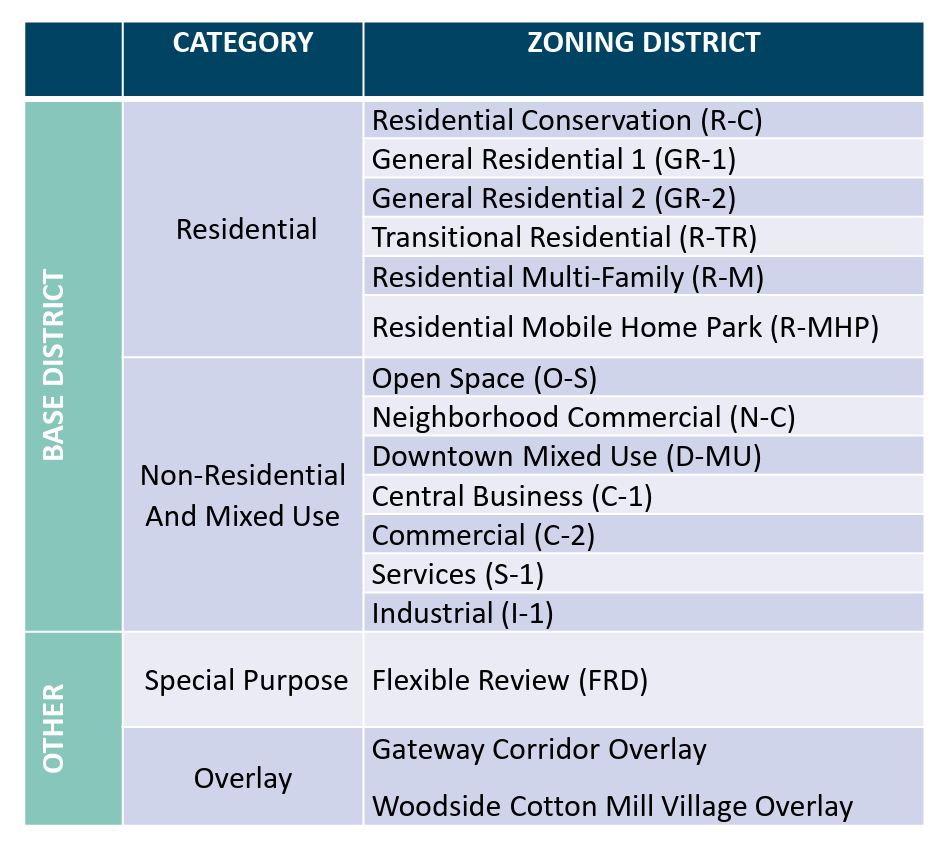
A few things to highlight here:
Creates a new Residential Conservation zoning. This zoning, while somewhat similar to our existing R-15 zoning, has some important changes that make this more reflective of what we’d all like to see in the outer parts of our city limits more often - larger lots, less dense housing, and more. Paired with the requirements on new streets, sidewalks, and tree protections (later in our document), this is markedly better than our current zoning.
Creates an Open Space zoning. This is a zoning district specifically for “…parks, open space and public and private recreational areas. Uses include active and passive recreation facilities, golf courses, preserved lands, gardens, agriculture and cemeteries. Structures may include those supporting recreation, outdoor amphitheaters or museums.”
This helps protect things like our parks which right now are nearly all zoned R-15 - meaning if for some reason they were to no longer be a park, they could have houses on them under different ownership. Note that this is different than our “Residential Open Space option” (more on that later).Creates an additional commercial zoning district to protect downtown area. Our current zoning only allows for three types of commercial, with only one of them meant for downtown (C-1). The proposed changes introduce a new downtown-oriented zoning, Downtown Mixed Use (D-MU). This helps support growth around our core downtown area that compliments our historic Main Street (think Wall Street to Woodside Avenue - those types of areas).
I also wanted to highlight the document itself here. Our previous zoning code was a series of confusing text articles, sometimes conflicting each other depending on the page you were on.
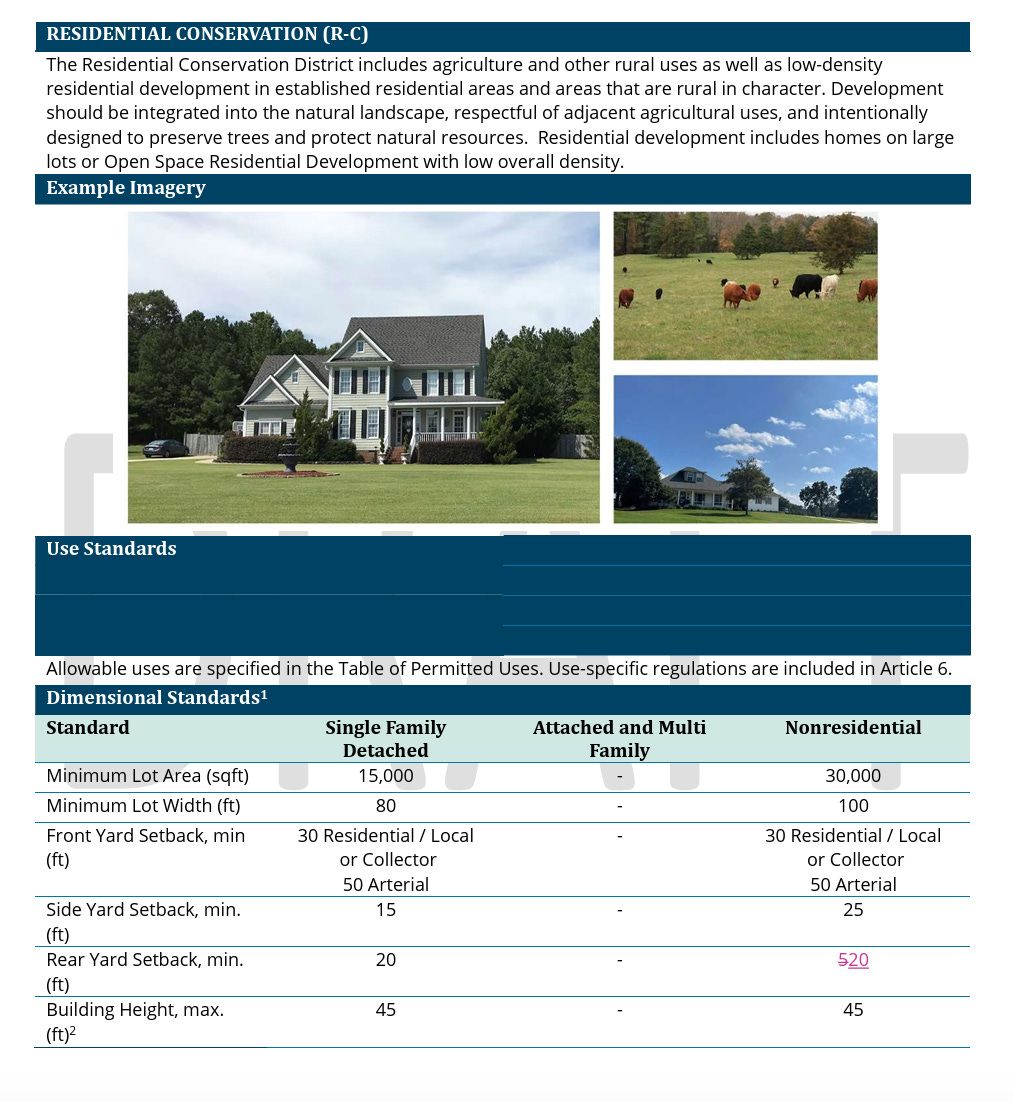
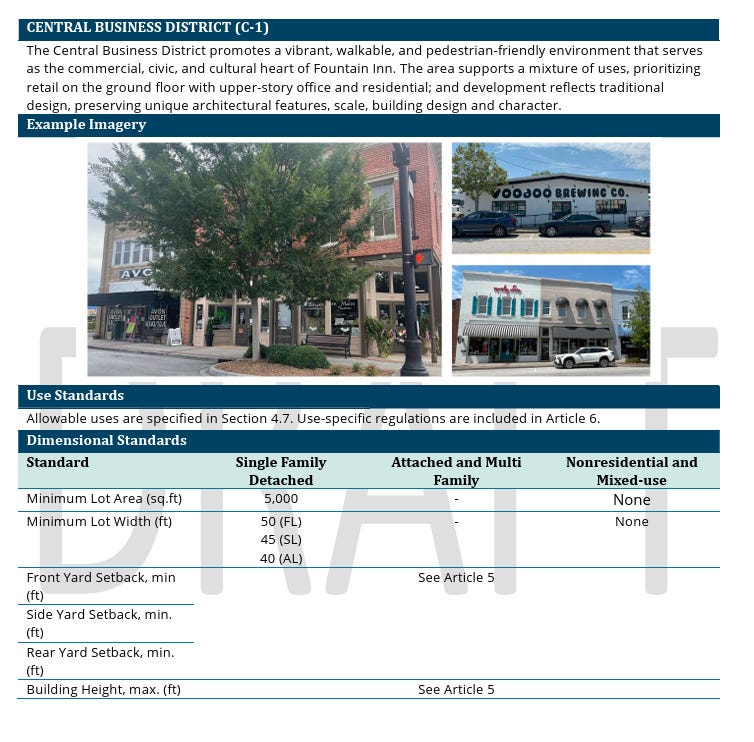
Our new code includes excellent overviews of each zoning district laid out in a visual manner that is easy to read and understand. While you may have to read some of the text before or after the overviews to dive deeper, the public and property owners now have a clear, single source of information to understand each zoning district.
Instead of writing a detailed overview for each zoning district, I thought it best to highlight this element of the document for you to learn about each one.
The following are samples from Section 4.3.2 and Section 4.3.3. They show the type of overview for each zoning district in the document. Folks should scroll through the draft (pages 65-78) to read more information for each district (adding pictures of all 14 doesn’t work the way you’d like it to on Substack’s platform).
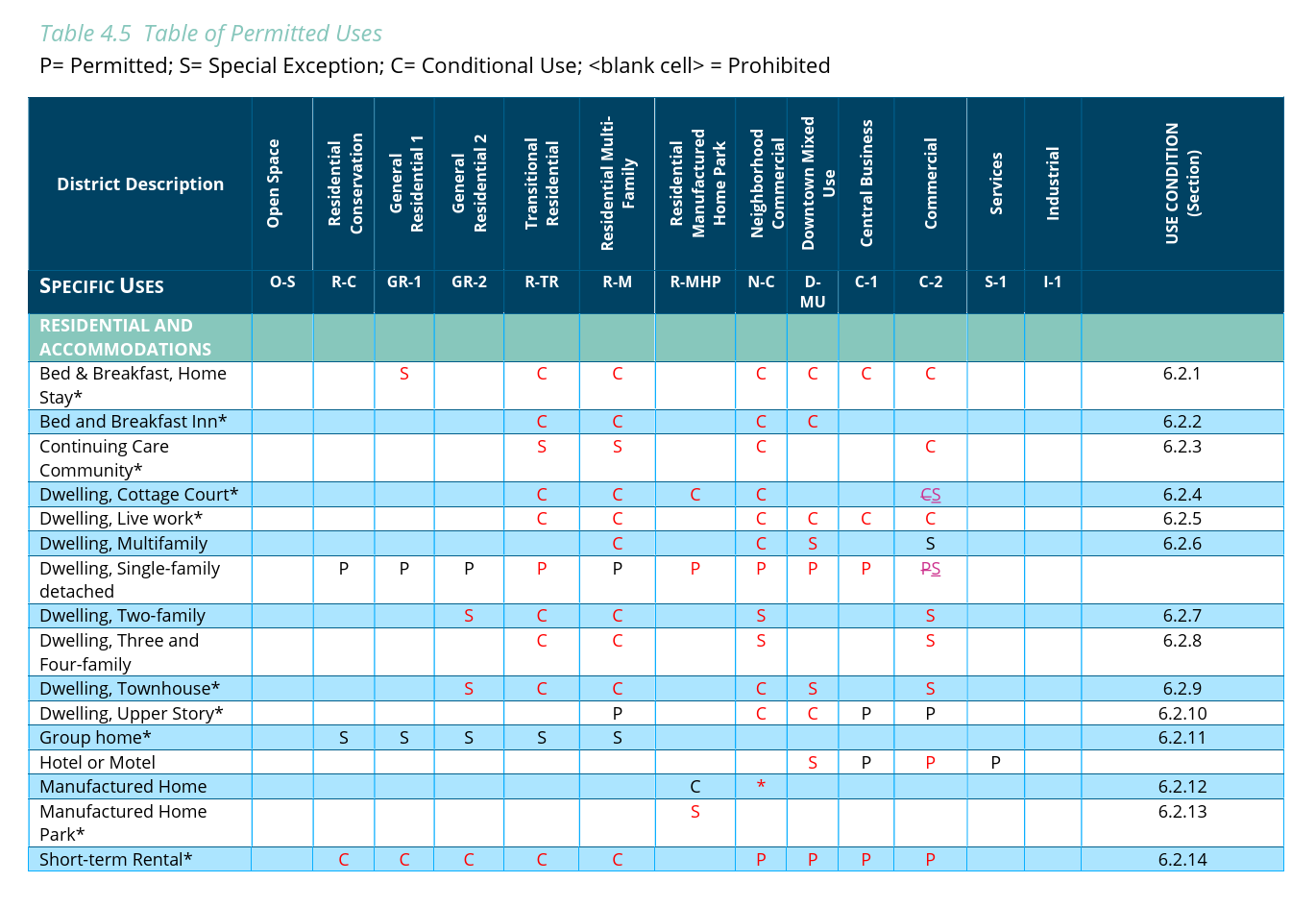
Another helpful element in our updated code is our “Table of Permitted Uses” (Table 4.5), also in Article 4. This combines our zoning districts with the types of specific uses allowed in each, and the process/approvals required. It’s a helpful quick guide to a majority of our zoning ordinance.
It labels each use as “Permitted”, “Conditional” (approved if certain requirements met), “Special Exception” (requires action by our Board of Zoning Appeals before approval), or “Prohibited” (blank cell).
Below is the first page of this chart to give you an idea of what’s in the document - the full chart can be found from pages 86-94 in the draft.
If you’re looking to take a small break - this is a good spot. I know this part was a little dense.
Article 5 - General Development Standards
This article covers some critical development standards for all of our zoning districts. In particular, I want to zoom in a few elements:
Open Space Option: A number of months ago, City Council approved an updated “Open Space” ordinance, including a new “Residential Open Space Option”. In what is the most land-protective open space option in Greenville and Laurens County, the policy adopted is carried over into our new update with only slight tweaks (that favor more open space protections). The purpose of this section is to encourage protection of natural elements of properties in every new development and, if taking the “Residential Option”, incentivize additional preservation.
All developments are required to preserve a minimum of 15% in “open space” (not developed) off the top - our previous code had no required open space.
If taking the “Residential Open Space Option”, a minimum of 40% of the property must be protected as open space. In exchange for taking this “option”, smaller lots are permitted to ensure 40% of the property can be preserved.
Two changes to note here in our rewrite:
The definition of “undevelopable land” is altered in an effort to ensure that developers don’t add stormwater ponds or creek beds, for example, to their % of open space calculation — the property preserved must consist of at least 50% “developable” land.
Requires that all “open space” must have a deed restriction or be placed into a conservation easement, ensuring its protection into perpetuity.
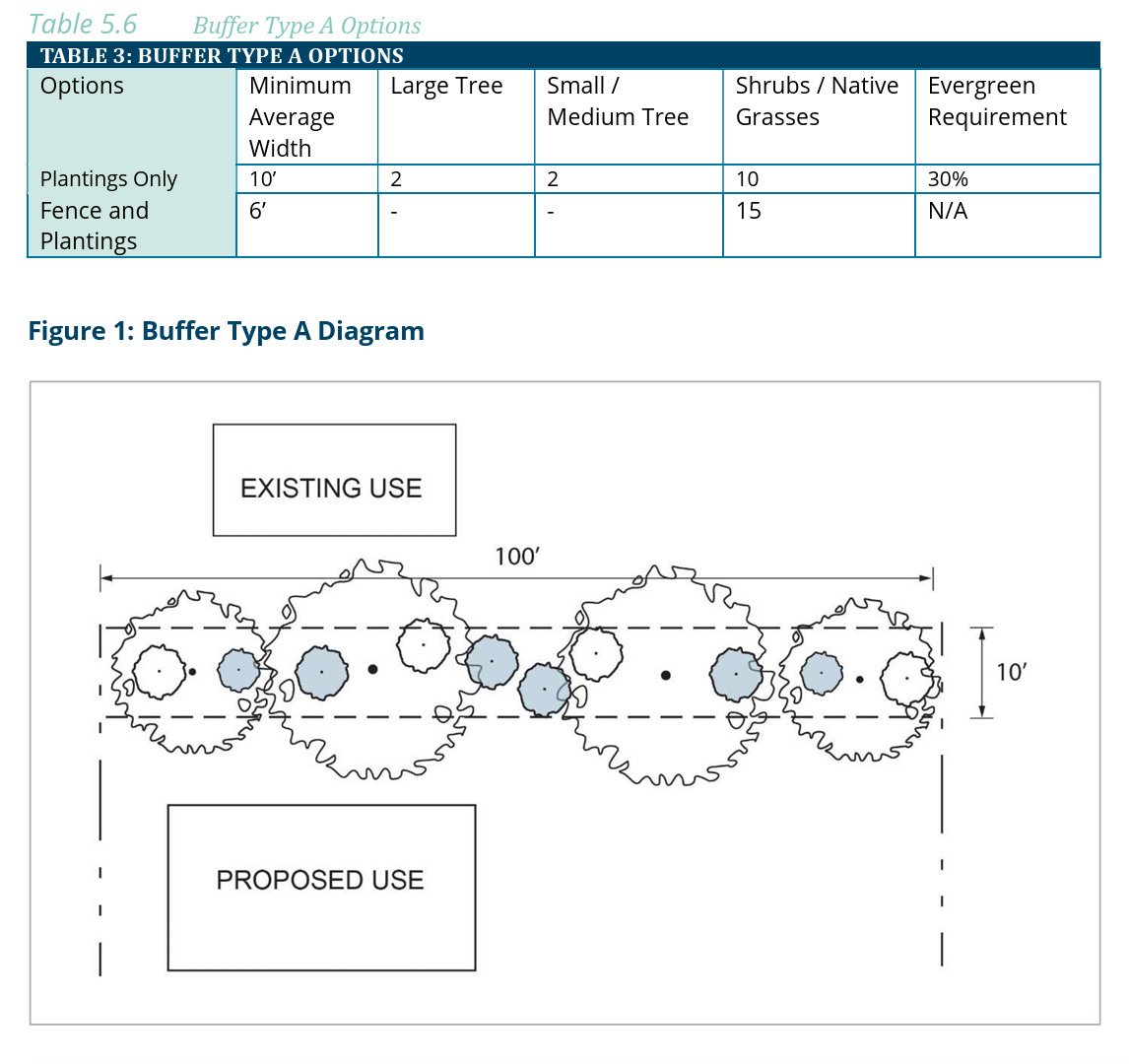
Buffers: Our proposed update includes greater clarity and definition to buffer requirements around developments - and expands them in many cases. To make it easier, the update also provides illustrative examples each type of buffer (below).
Tree Protection: Our current ordinance does not protect trees well enough, in fact it’s nearly silent in regards to any meaningful tree protection requirements. Our proposed ordinance protects more trees than ever before and prioritizes the protection of existing tree cover, requires re-planting of trees, and provides for financial penalties if requirements are not met (penalties which go to planting more trees).
Article 6 - Conditional Use & Special Exception Use Standards
This is an important part of our code because it clarifies how some types of uses may be approved, but not automatically. For many types of uses, there is a community interest in making sure certain requirements are met to minimize neighboring properties experiencing negative impacts, or to ensure safety and well being of those on-site. This includes uses such as some unique residential developments (e.g. “cottage courts”) and some business types (e.g. childcare centers).
“Conditional Uses” are those that require some level of staff review before obtaining approval and are compliance-related (e.g. is the fence tall enough as required), and “Special Exception Uses” are those that require approval by our Board of Zoning Appeals (e.g. all schools require approval by the BZA).
A couple of specific changes I wanted to highlight:
Accessory Dwelling Units (ADUs): As we’ve seen at many homes across our community, adding an “in-law suite” or garage apartment is becoming more common. ADUs have become popular for younger adults who live with their families, aging parents moving close to their children, and also as guest suites for visitors coming in for family events. ADUs previously were challenging for property owners in our existing code - our code wasn’t really written with them in mind and it would often be burdensome on a homeowner.
I’m a believer in property rights - and as long as a homeowner can add these types of units to their homes safely and up to all building codes (including parking), then our code should provide appropriate permission for it.
Home Occupations: The draft provides a better list of more modern home occupations that will be eligible for home occupation. The draft was written/finalized prior to a recent amendment approved by City Council that provided greater clarity for things such as vegetation (flowers, vegetables, etc), animal products (e.g. eggs, honey), and the like to not be classified as “supplies” - that change will be reflected as the draft is updated.
I will be proposing another change here. In addition to our redefinition of “supplies” noted above, I will be proposing that we switch to a list of “prohibited occupations” instead of only a list of “permitted occupations”. We can’t predict what type of innovation and/or entrepreneurship will be home-based in the years to come, nor should we restrict it as long as there are no adverse affects on neighboring properties.
Short-Term Rentals (STRs): Our current code is silent on STRs (AirBnB, VRBO, etc), which has created challenges at times for homeowners, neighbors, and our staff. Centered on property rights first, our draft ordinance permits STRs, however it provides for the following protections:
Cannot be rented for special events/parties.
Limited to two (2) persons per bedroom + 2 additional individuals.
Parking must be provided on-property.
Owner must obtain a business license annually (and remit requisite Accommodations Tax).
Whole homes can be rented, as can individual rooms - however multiple rooms may not be rented out separately.
Note that “Short-Term Rental” is defined in Article 10 as “Any dwelling, or a part thereof, rented for less than 30 days.”
Provide Your Input
I encourage everyone to take time to read through our proposed draft, and I especially encourage you to share any comments you may have through our public comment form online — links to all of this can be found here.
Up Next: In my next post, I’ll cover the last four articles - parking/streets, signs, utilities, and definitions. (Articles 7-10 if you want to read ahead here.)
Status Update: As of this blog’s publish date, the proposed draft is being reviewed by our Planning Commission, Board of Zoning Appeals, and City Council. There was a City Council Workshop on this topic held October 21 (view the slides here), and a joint Planning Commission and Board of Zoning Appeals review held on November 6.
The draft document is still a draft, subject to amendment. Neither the Planning Commission or City Council have taken action on the draft, nor is it on the agenda for City Council in November. It must first have a vote by the Planning Commission before heading to City Council. Planning Commission will first have this for discussion and potential action in December.
Disclaimers:
My summaries are not exhaustive of every section and sub-section of every article, but rather a “highlight reel” so that you are informed on overall themes, major changes, and/or specific changes I think are particularly good to lift up.
My comments are also not necessarily reflective of every member of City Council, the Planning Commission, or our staff - they are my thoughts alone.
I also want to stress that the document is currently a draft, wholly open to amendment by the Planning Commission and City Council.